
Ontology Under Pressure: Part Two. From Armchair Metaphysics to Scientifically Disciplined Ontology
How modern science and technology forced ontology beyond intuition and static categories.



In Ontology Under Pressure: Part One – When AI “Discovers” Laws of Nature, What Exactly Has Been Discovered?, we examined a contemporary AI-driven scientific result and showed how easily representational success is mistaken for ontological discovery. What was framed as the uncovering of governing laws was, on closer inspection, the production of compact, predictive representations shaped by data, constraints, and modeling choices.
That confusion was not treated as a rhetorical error or a failure of rigor. It was treated as a symptom. This second part explains why that symptom appears so reliably, and why ontology itself has had to change in response.
From epistemic scarcity to epistemic pressure
Classical metaphysics emerged under conditions that are easy to forget from a modern vantage point. For most of its history, philosophy operated under extreme epistemic scarcity. Observation was limited to unaided human perception. Causal explanations were coarse grained and largely qualitative. Introspection and common-sense categories carried enormous weight because there were few alternatives.
Within that context, it made sense that ontology focused on substances, stable objects, and enduring kinds. Aristotle’s ousia, the notion of a thing that persists through change while bearing properties, was not an arbitrary choice. It reflected the best explanatory resources available at the time. Chairs endured. Trees grew but remained trees. People aged but remained people. The world appeared naturally carved into discrete, stable units.
Modern science has reversed almost every one of those conditions.
We now observe entities far below and far above the human scale. Genes, proteins, quarks, black holes, and galactic filaments are not theoretical curiosities. They are operationally indispensable. Causation is no longer assumed to be linear or deterministic. It is modeled probabilistically, dynamically, and often across interacting systems. Many things once treated as objects dissolve under analysis into processes, fields, flows, or networks of dependency.
The result is a fundamental shift in how ontology must proceed.
Ontology is no longer guided primarily by what seems to exist from the human point of view. It is guided by what must exist in order for our best scientific explanations to work. That does not mean ontology becomes subordinate to any particular scientific theory. It means that ontological commitment is constrained by explanatory necessity rather than by intuition alone.
This creates a permanent tension that contemporary ontology must manage rather than resolve. Ontology must remain philosophically realist, committed to a mind-independent world. It must remain sensitive to scientific theory dependence, recognizing that our best explanations evolve. And it must serve practical representational needs in data, computation, and reasoning systems.
Ontology today is not armchair metaphysics refined. It is metaphysics under experimental pressure.
The AI modeling case examined in Part One is simply a contemporary manifestation of this pressure, where representational power outruns ontological clarity.
Technology as an ontology generator
Science is not the only force reshaping ontology. Technology now actively generates new kinds of entities that did not previously exist.
Digital files, datasets, simulations, and computational models are not mere abstractions. Algorithms, workflows, and machine learning models are not just descriptions of procedures. Virtual objects, avatars, and digital twins participate in causal chains that have real-world consequences. Information artifacts are embedded in physical substrates, but they cannot be identified with those substrates without loss.
These entities share several striking properties.
They are real in causal, social, and economic senses. They depend on physical realization, but they are not reducible to any particular physical configuration. They exhibit identity conditions that differ sharply from traditional substances. A dataset can persist through copying, migration, and transformation in ways no physical object can. A trained model can be instantiated simultaneously in multiple locations without being duplicated in the ordinary material sense.
These phenomena force ontology to confront categories that classical metaphysics barely anticipated.
Information artifacts must be treated explicitly, not as convenient fictions. Generically dependent entities must be distinguished from independent material things. Computational processes must be recognized as genuine occurrents with structure and constraints. Socio-technical hybrids, systems that intertwine people, rules, artifacts, and machines, must be modeled as more than loose aggregates.
Frameworks such as Basic Formal Ontology respond to these pressures by introducing layered distinctions. Independent continuants are separated from dependent continuants. Material entities are distinguished from information content entities. Occurrents are separated from continuants.
These distinctions are no longer theoretical luxuries. They are under constant stress from hybrid cases that strain simple classification. A machine learning model is an information artifact, but it also participates in processes and produces material effects. A legal contract exists as information, but it also generates obligations and powers that shape behavior.
Technology has not merely expanded the domain of ontology. It has made ontological precision operationally necessary.
The collapse of naive object-hood
Perhaps the deepest challenge to classical ontology comes from the collapse of naive objecthood across multiple sciences.
In biology, the idea of the organism as a well-bounded individual has become increasingly difficult to sustain. Organisms are ecosystems composed of host cells and microbiomes. Boundaries are porous. Identity is maintained through ongoing regulation rather than static structure. Species boundaries are historically contingent and genetically fluid. Developmental processes show that what an organism is cannot be separated cleanly from how it becomes.
In physics, particles are no longer tiny billiard balls. They are excitations of fields. Identity over time is context dependent. Persistence conditions that work at macroscopic scales fail at quantum scales. The notion of a thing that remains numerically identical while changing properties becomes deeply problematic.
In cognitive science, mental states are not localized objects. They emerge from distributed neural processes interacting across time. Intentional objects, the things thoughts are about, may lack clear physical correlates. A belief, a memory, or a goal cannot be pointed to in the way a chair can.
Across these domains, the same lesson repeats. The world is not naturally divided into well-bounded, enduring objects at every scale. Many entities are vague, overlapping, temporally indexed, or processual. Identity is often something achieved and maintained, not something given.
For ontological modeling, this raises hard questions.
How should we represent entities with indeterminate boundaries? How should we model entities whose identity depends on ongoing processes rather than static essence? How should we capture multiscale dependence relations where what exists at one level depends on patterns at another?
The answer cannot be to abandon realism. The fact that objects are not always simple does not make them unreal. It means ontology must become more flexible without becoming incoherent. A process-friendly ontology is required, but one that still supports stable reference, constraint, and explanation.
From taxonomies to explanatory ontologies
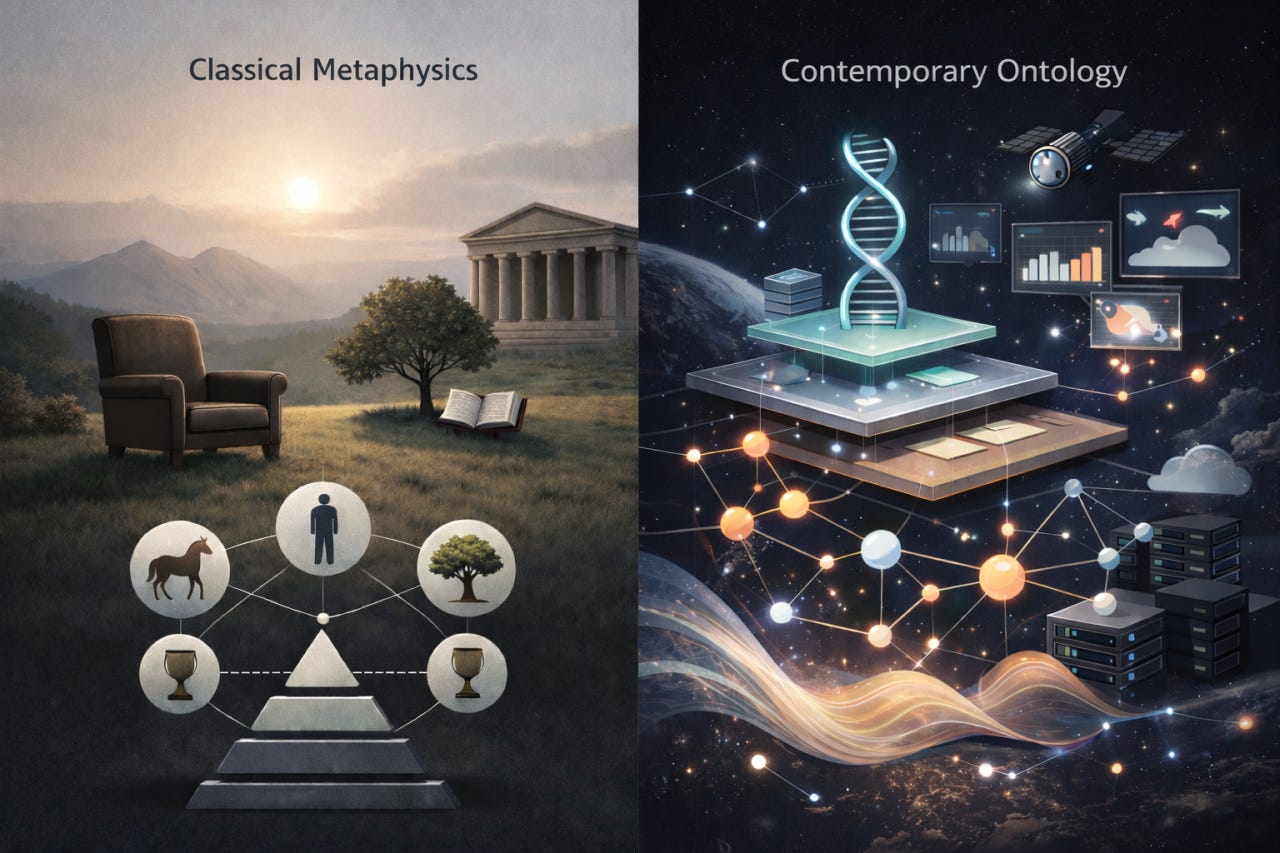
Classical metaphysics often sought categorical completeness. The aim was to enumerate the fundamental kinds of being once and for all. Contemporary ontology cannot afford that ambition.
Instead, ontology must prioritize explanatory adequacy.
Modern ontological models are judged not by elegance alone, but by whether they align with scientific practice, support data integration and interoperability, and encode the constraints and dependencies that actually matter in a domain. This shifts the guiding question of ontology.
The central question is no longer simply what kinds of things exist. It is what distinctions must be represented for this domain to function correctly.
This does not render ontology arbitrary or purely instrumental. Purpose sensitivity enters at the level of modeling, not at the level of metaphysical commitment. An ontology of biology and an ontology of finance will represent different distinctions, not because reality changes, but because different explanatory and operational demands are in play.
This has structural consequences.
Upper ontologies must remain sparse, stable, and conservative. They provide the scaffolding that supports interoperability and long-term coherence. Domain ontologies, by contrast, proliferate and evolve rapidly. They track scientific advances, technological change, and shifting institutional practices.
The success of an ontology is no longer measured by how comprehensive it is in isolation, but by how well it mediates between levels, domains, and uses.
Temporalization of being
Static class hierarchies are increasingly insufficient for representing how many entities actually exist. Development, evolution, learning systems, versioned knowledge artifacts, and institutional roles all unfold in time. Roles begin and end. States are entered and exited. Information artifacts evolve through revision, replacement, and obsolescence.
Ontological realism must therefore be reconciled with temporality. Existence is not always timeless. Being often has a history.
One way this pressure manifests is in entities whose very existence is temporally bounded by epistemic or contextual conditions. Some things do not merely change over time; they exist only within a determinate temporal interval, beginning with a triggering event and ending with a resolving event. Their persistence conditions are not defined solely by material continuity, but by the satisfaction or dissolution of specific conditions.
This insight is developed explicitly in recent ontological work on bounded temporality, where entities are modeled as existing only within well-defined temporal regions whose boundaries are grounded in events of detection, recognition, or resolution. This work was presented at CAOS 9, as part of JOWO at FOIS, in Catania, and a full paper elaborating the framework is forthcoming.
What matters ontologically is not merely when something exists, but why it exists during that interval at all.
Bounded temporality generalizes well beyond any single application domain. Legal roles, diagnostic states, institutional statuses, investigative hypotheses, permissions, alerts, and certain classes of information artifacts all exhibit this structure. A role such as “suspect” exists only between accusation and exoneration or conviction. A diagnostic condition exists only while its criteria are satisfied. A model version exists only until it is superseded. In each case, temporal boundaries are not arbitrary timestamps, but are grounded in events that alter the ontological status of the entity itself.
This reframes temporality as a first-class ontological concern rather than a secondary annotation. Time is not merely something entities are indexed against. For many entities, time is part of what they are.
For ontological modeling, this has significant consequences. It requires representing entities whose identity conditions include their temporal bounds, whose persistence depends on processes rather than substances, and whose termination is as ontologically meaningful as their initiation. Ontologies that treat time as an external parameter rather than an internal structural feature will systematically misrepresent such entities.
The lesson is not that ontology must abandon stable identity. It is that stability itself is often temporally achieved. Ontological realism survives not by denying change, but by modeling it with discipline.
New challenges for ontological modeling
Several challenges now define the current frontier of ontological work. They are not independent problems, but recurring fault lines where representational practice, scientific explanation, and ontological commitment tend to pull apart.
Granularity Management
Different sciences describe reality at incompatible levels. Molecules, cells, tissues, organisms, and populations are all real, but none can be reduced cleanly to the others. Signals, symbols, and meanings coexist, but they obey different constraints and participate in different kinds of explanation.
Ontologies must therefore support cross-granular mappings without collapse or duplication. They must allow entities at one level to depend on entities at another without forcing premature reduction or vague hand-waving. Granularity is not a defect to be eliminated, but a structural feature to be managed.
Representation and Reality
Scientific models, simulations, and measurements occupy a peculiar ontological position. They are about reality, but they are also entities within reality. A climate model is not the climate, but it exists, changes over time, and exerts causal influence through the decisions made on its basis.
Ontological modeling must therefore distinguish what exists from what represents what exists, while also accounting for how representational entities themselves exist, persist, and act. This distinction is especially critical in AI and data science, where models increasingly participate directly in decision-making processes.
Normativity and Social Ontology
Technological systems increasingly encode rules, roles, obligations, and institutional facts. These are not reducible to physical entities, but they have real causal force. A credential grants access. A regulation constrains action. A contract creates obligations that shape behavior.
Ontological modeling must integrate social reality and normative structure without collapsing them into psychology or physics. Roles, permissions, and institutional statuses must be treated as real components of the world that systems act within, not as optional annotations layered on afterward.
The emerging paradigm
What is emerging is not an anti-metaphysical stance, but a post-naive one.
Contemporary ontology is realist, committed to a mind-independent world. It is layered, recognizing multiple ontological strata with different identity and dependence conditions. It is fallibilist, open to revision as science advances. And it is application-driven, constrained by empirical and computational utility.
Ontology today functions less like a finished system and more like an infrastructure. It is stable at the top and adaptive at the edges. It provides shared commitments that enable coordination without freezing inquiry.
Conclusion
Technological and scientific advances have not invalidated classical metaphysical insights. They have exposed their underspecification. The enduring categories of ontology remain, but they must now be sharpened, disambiguated, and operationalized.
Ontological modeling has become a discipline of mediation. It mediates between philosophy and science, between stability and change, between what exists and how we must represent it in order to know it, reason about it, and act within it.
This is not a retreat from metaphysics. It is metaphysics grown up, tested by reality, and made responsible to the systems that now depend on it.
In Part Three, we will show how a realist, layered ontology such as Basic Formal Ontology is designed precisely to withstand these pressures, separating prediction from explanation and representation from ontological commitment by design.
About Interstellar Semantics
Interstellar Semantics helps organizations design and operationalize formal ontologies and enterprise meaning structures grounded in open standards such as RDF, OWL, and SPARQL. As platforms consolidate and infrastructure layers grow more opaque, we help clients retain control over meaning, ensure interoperability across systems, and build semantic foundations that remain stable through re-platforming and AI adoption.
We are currently taking on a select group of clients.
If your organization is preparing for a future where semantic clarity, formal modeling, and ontological rigor are first order concerns, we’re here to help.
 | A guest post by
|
This rings very true: “Ontological modeling has become a discipline of mediation” - a lot of my practice works with mediation between ontology as schema and ontology as meaning.
From your two articles, I suggest you consider that my RGEM method and tools aligns with—and arguably exemplifies—the emerging ontology described in Ontology Under Pressure by explicitly separating representation from reality, embedding time and process into identity, supporting layered explanation, and governing ontology as an adaptive, operational system rather than a static metaphysical catalog.